
For New Zealand players comparing online casinos, odds matter just as much as game choice. They influence how much a game returns over time, how quickly a balance can change, and whether a particular format suits a player’s budget. This overview looks at how to assess the odds available at 24 Casino, what the numbers can—and cannot—tell you, and which checks are useful before depositing.
Casino odds vary by title, provider, and sometimes by the version of a game. A familiar name does not guarantee identical rules everywhere. The most reliable approach is to inspect the game information and terms shown on the casino platform, then compare those details with your own preferences. No published figure can predict the result of an individual session.
Understanding casino odds
In online casino games, “odds” can refer to several different things. For slots, players usually look at the return to player (RTP), volatility, and hit frequency. For table games, odds depend on the rules and decisions available. In live games, the payout table and house edge are especially relevant. These measures describe different aspects of play, so they should not be treated as interchangeable.
RTP is a long-term measure
RTP is the theoretical percentage of wagers a game returns to players over an extremely large number of rounds. A slot with a stated 96% RTP is designed, in statistical terms, to return an average of $96 for every $100 wagered across extensive play. It does not mean that a player will receive $96 back after wagering $100 in one session. Short-term outcomes can be much higher or lower.
RTP is not a guarantee, a forecast, or a promise of a particular result. It is most useful for comparing games when the figures are supplied by a dependable source and refer to the exact version being played. If a game’s information panel does not display its RTP, check the provider’s official game details or ask the casino’s support team where to find them.
Volatility describes the shape of results
Volatility, sometimes called variance, gives a broad indication of how a game’s outcomes are distributed. A low-volatility slot may produce smaller wins more frequently, while a high-volatility slot may have longer quiet periods and less frequent, potentially larger payouts. Medium-volatility games sit between those general patterns. The labels are descriptive rather than predictive: even a low-volatility game can have a losing session.
Hit frequency is another useful but limited statistic. It indicates how often a game may produce a win, but a “win” can be smaller than the stake. A high hit frequency therefore does not automatically mean frequent profit. Read it alongside the paytable, RTP, and volatility rather than using it as a standalone measure.
What Kiwi players should check at 24 Casino
24 Casino Digital Platform:
Before choosing a game, open its information or help screen and review the rules, payout table, minimum and maximum stake, and any feature-round conditions. If the platform lists more than one RTP configuration, confirm which version is currently available. Game details can differ between operators, so information from a general online guide may not match the version loaded at a casino.
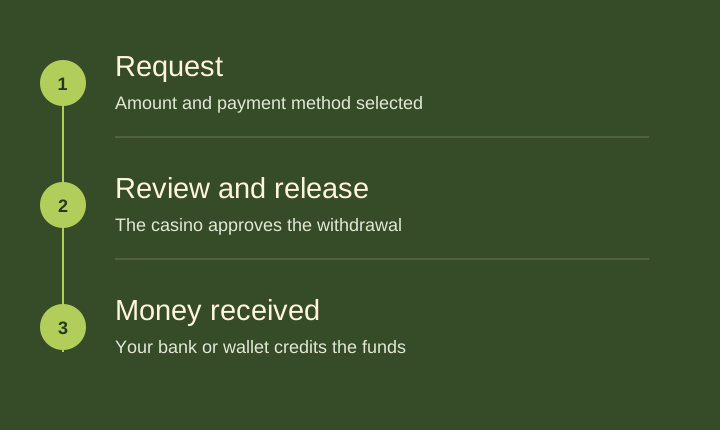
New Zealand players should also check practical account details before making a payment. Look for the available deposit and withdrawal methods, transaction limits, processing times, verification requirements, and any currency conversion costs. A game’s theoretical return does not account for banking fees or exchange rates. If your account is held in another currency, the final amount credited or withdrawn may differ from the amount you initially expected.
- Read the game rules: Confirm how paylines, bonus rounds, side bets, or special features work.
- Check the displayed RTP: Use the figure for the exact game version, not a number copied from an unrelated listing.
- Review stake limits: Choose a game whose minimum wager fits the budget you set.
- Inspect bonus terms: Wagering requirements and game restrictions can affect how promotional funds may be used.
- Set limits in advance: Decide on a spending and time limit before starting, and stop when either is reached.
Comparing game types by odds
Slots are easy to browse but can vary greatly in volatility, mechanics, and jackpot structure. A progressive jackpot may offer the chance of a large top prize, but the chance of landing it is generally very small. The headline jackpot should not distract from the ordinary paytable or the stake required to participate.
Table games often make their mathematical structure easier to examine. In blackjack, for example, the house edge depends on the rules and the player’s decisions. The number of decks, dealer rules, doubling options, and whether the game pays 3:2 or 6:5 for a natural blackjack can all matter. Baccarat has comparatively simple betting choices, but each option carries different probabilities and commissions may apply to a winning banker bet.
Roulette odds depend on the wheel. A single-zero European wheel has different probabilities from a double-zero American wheel because the extra pocket changes the distribution of outcomes. Check the table layout and game rules rather than assuming that every roulette title offers the same odds. Live dealer presentation can make the experience feel more social, but it does not remove the built-in house edge.
Odds do not make a system reliable
Betting progressions, “due” numbers, and patterns in previous spins cannot change the underlying probability of a random game. A run of losses does not make a win inevitable, and increasing a wager to recover losses can make a budget disappear faster. Strategies can help players follow rules in some games, but they cannot guarantee profit or overcome the house edge in the long term.
Questions and answers
Can 24 Casino odds predict whether I will win?
No. Odds and RTP describe statistical expectations over many rounds, not the outcome of a particular spin, hand, or session. Random results can vary widely in the short term.
Is a higher RTP always the best choice?
A higher RTP can be a useful comparison point when the figures are verified and refer to equivalent game versions. It does not necessarily mean that a game will suit your preferred pace or risk tolerance. Consider volatility, rules, stake limits, and whether you understand the game.
Does a bonus change a game’s odds?
A bonus does not ordinarily alter the game’s mathematical settings, but its terms can affect the practical value of an offer. Check wagering requirements, eligible games, maximum bet rules, expiry dates, and withdrawal conditions. Do not deposit solely because a promotion appears generous.
How can I find the odds for a specific game?
Open the title’s help, rules, or information menu and inspect its paytable and RTP details. If these are unavailable or unclear, contact casino support or consult the game provider’s official information. Avoid relying on unsourced figures from third-party pages.
A sensible way to choose
A useful comparison starts with the kind of experience you want, not with the biggest advertised payout. Players who prefer steadier, smaller fluctuations may favour lower-volatility games, while those comfortable with more variable results may explore higher-volatility titles using only a modest, predefined budget. Neither preference improves the mathematical chance of winning; it simply helps align the game with a player’s risk tolerance.
Try unfamiliar games in free-play mode when it is available. This can help you understand controls, paylines, and bonus features without risking money, although practice results do not predict real-money outcomes. When switching to paid play, begin at a stake you can afford to lose. Avoid borrowing, chasing losses, or treating casino play as a way to earn income.
For New Zealand users, responsible play also means confirming that online gambling is lawful for their circumstances and understanding the rules that apply to them. Check the casino’s current licensing and account terms rather than assuming that availability alone confirms regulatory status. If gambling stops feeling recreational, take a break and seek support from a trusted person or an appropriate New Zealand gambling-help service.
Final assessment
24 Casino players can make more informed choices by separating RTP, volatility, hit frequency, and game-specific house edges. Each measure answers a different question, and none removes uncertainty. The best starting point is to verify the information for the exact game, compare its rules and limits, and decide on a firm budget before playing.
For Kiwi players, the overall decision should include more than odds: payment conditions, currency handling, bonus restrictions, support access, and responsible-gambling tools all deserve attention. Treat casino games as entertainment, regard any stake as money that may be lost, and never interpret a theoretical return as a personal promise.